
Gen 13: The Movie
From Comic Book To Animated Feature
By the middle of the 1990s, WildStorm Productions was no longer content to be simply a successful comic book publisher. The company was actively exploring how its characters could move into animation, film, and other forms of entertainment, but the experience of WildC.A.T.s had also demonstrated how much creative control could be lost when a comic book property entered the traditional television system.
Gen 13 offered WildStorm a chance to try something different. The company would develop an animated feature on its own terms, drawing on established American animation talent while experimenting with the direct-to-video OAV (Original Animation Video) model. What followed was a production that took years to complete, attracted Disney as its domestic distributor, premiered publicly in 1998, and ultimately became one of the strangest release stories in WildStorm history.
Created by Jim Lee, Brandon Choi and J. Scott Campbell, Gen 13 was built around a group of young characters whose lives were transformed by the discovery that they possessed extraordinary powers. The concept was ideally suited to the kind of multimedia expansion WildStorm was pursuing, but the company wanted to approach animation on its own terms.
The result was an ambitious animated feature that would spend roughly three years moving through development and production, eventually becoming one of the most unusual lost films of the 1990s, and receive a public premiere without ever receiving a commercial release in the United States.The strange history of Gen 13 begins with a relatively straightforward idea: WildStorm wanted to make its own movie.
Why WildStorm Wanted Its Own Animated Movie
The experience of WildC.A.T.s was an important part of the thinking behind the Gen 13 project.
WildStorm had already watched one of its major properties become an animated television series, but television production brought compromises. Networks had standards to satisfy, broadcast requirements to meet, and limitations on what could be shown or how stories could be told. For a company accustomed to having creative control over its comics, that could be frustrating.
Gen 13 was therefore conceived as something different.
Rather than beginning with a television network and building a series around its requirements, WildStorm pursued an animated feature intended for direct-to-video distribution. Contemporary reporting described the project as an American experiment with the Japanese OAV (Original Animation Video) model.
The distinction was important. WildStorm could make the film it wanted first and then find a distributor for it.
In a November 1997 article for Animation World Magazine, director Kevin Altieri and WildStorm executive John Nee discussed the project as an attempt to maintain creative control while developing animation outside the traditional television system. The film was not being designed specifically for young children, and plans called for versions that could accommodate different ratings, including G and PG-13.
That philosophy helps explain why Gen 13 occupies such an interesting place in WildStorm history. It was not simply an existing comic being licensed to an outside animation company. WildStorm was attempting to build an animation project from within the company itself.
Kevin Altieri
The person brought in to turn that ambition into a movie was Kevin Altieri.
Altieri was already known for his work on Batman: The Animated Series, and his background made him a natural fit for what WildStorm was attempting. He had also been pursuing an animated adaptation of Mike Mignola’s Hellboy before that project failed to materialize. Jim Lee subsequently offered him the opportunity to work on Gen 13.
For Altieri, the appeal was not simply the chance to animate another superhero property. The Gen 13 project offered an opportunity to make animation that could be aimed at an older audience rather than being constrained by the conventions of children’s television.
That connection to the emerging 1990s American animation movement is one of the film’s most interesting historical details. Altieri came out of the Batman: The Animated Series generation of sophisticated American television animation, while character designer Glen Murakami, who worked on the early development of Gen 13, would go on to become one of the major creative figures behind Superman: The Animated Series.
For a WildStorm production, the creative pedigree was impressive. The problem was that getting a movie from that pedigree to a finished film would prove considerably harder than anyone expected.
Production Begins
Contemporary reports place the beginning of Gen 13’s production around 1995.
A Wizard magazine article from April 1995 was already reporting on the developing project, including a feature titled “Generating Gen 13: A Slow Process.” Character designs started to circulate later that year. In November 1997, Animation World Magazine reported that WildStorm had been working on the project for approximately two years.
WildStorm’s decision to maintain an animation operation in Santa Monica was significant. The company was not merely commissioning a finished cartoon from a distant studio. It was attempting to establish the infrastructure necessary to produce animation itself.
Glen Murakami contributed character designs during the development of the film before leaving the project to work on Superman: The Animated Series. His involvement provides an especially interesting connection between the WildStorm project and the contemporary DC animation world.
The production itself became increasingly complicated.
The original target had been considerably earlier than the eventual 1998 premiere, but Gen 13 was not a project that could simply be rushed into existence. WildStorm was working with a relatively small budget compared with major animated features, while simultaneously competing for animation talent with much larger studios.
Some members of the production staff were reportedly recruited away by companies such as DreamWorks and Warner Bros. Animation. Those studios could offer longer-term contracts and considerably greater resources, while an independent WildStorm production could not necessarily offer the same security.
The result was delay after delay.
What had once looked like a relatively quick experiment in direct-to-video animation became a much longer production.

Glen Murakami
September 4, 1995

Glen Murakami
September 4, 1995

Glen Murakami
September 5, 1995

Glen Murakami
September 6, 1995
An American OAV
The Japanese OAV (Original Animation Video) model was an important influence on the project.
Rather than thinking of Gen 13 as a Saturday-morning cartoon, WildStorm was approaching it as a self-contained animated feature that could be sold directly to the home-video market. That distinction also affected the intended audience. Contemporary reporting specifically noted that the film was not being developed for young children. The producers were considering both G and PG-13 versions, with the possibility of adapting the material depending upon distribution requirements. The project was therefore caught between two worlds.
It was based on a comic book featuring teenagers and superheroes, but WildStorm did not necessarily see that as synonymous with children’s entertainment. The company wanted the freedom to preserve more of the attitude and content of the comic. In many ways, this was exactly the kind of experiment that made sense for WildStorm in the mid-1990s.
It was also expensive.
The Budget Grows
Early reporting associated Gen 13 with a budget of approximately $2 million. By late 1997, however, Animation World Magazine reported a budget of roughly $4 million. The surviving sources do not provide a complete accounting of why the reported figure increased so substantially, so the safest conclusion is simply that the project had grown considerably more expensive during production.
That increase was significant for a direct-to-video experiment. WildStorm had put real money and considerable time into the film, and the company was now looking toward the home-video market to recover that investment.
Kevin Altieri was optimistic. Very optimistic. When asked about the commercial prospects of the project, he expressed the belief that it would “make a mountain of cash.”
For WildStorm, the gamble was becoming much larger. And then along came Disney.
Disney Enters The Picture
Disney’s involvement transformed the story. By 1997, Buena Vista Pictures had acquired domestic distribution rights to the animated Gen 13 film. Disney had also acquired rights to develop a live-action Gen 13 movie.
Suddenly, WildStorm’s independent animation experiment had the backing of one of the biggest entertainment companies in the world.
The arrangement appeared to give Gen 13 a path into the American market that the production had been working toward since the beginning. There was even discussion of the property expanding beyond the feature film. An animated television series was considered, while the live-action project represented an even larger potential expansion of the franchise.
For a few years, Gen 13 was not simply a comic book getting a cartoon. It was becoming a multimedia property. And then the production finally reached the point where there was actually a movie to distribute.
The Final Stages Of Production
By the fall of 1997, contemporary reports indicated that the film was approximately 60 percent complete. The long production was finally moving toward its conclusion. Eventually, the first completed cut of the film was assembled.
The rating issue that had been hanging over the production also began to disappear. Earlier plans had contemplated creating different versions of the film for different audiences, but by early 1998 Disney was reportedly satisfied with the finished movie and plans for alternate edited versions were dropped.
That detail is particularly important when considering what happened later. There is a persistent tendency to explain the eventual disappearance of Gen 13 by saying that Disney objected to its content. But the contemporary evidence does not support presenting that as established fact.
At least by early 1998, the available reporting indicated that Disney was satisfied with the film.
The movie was finished. It had a distributor. And it was about to be shown to the public.
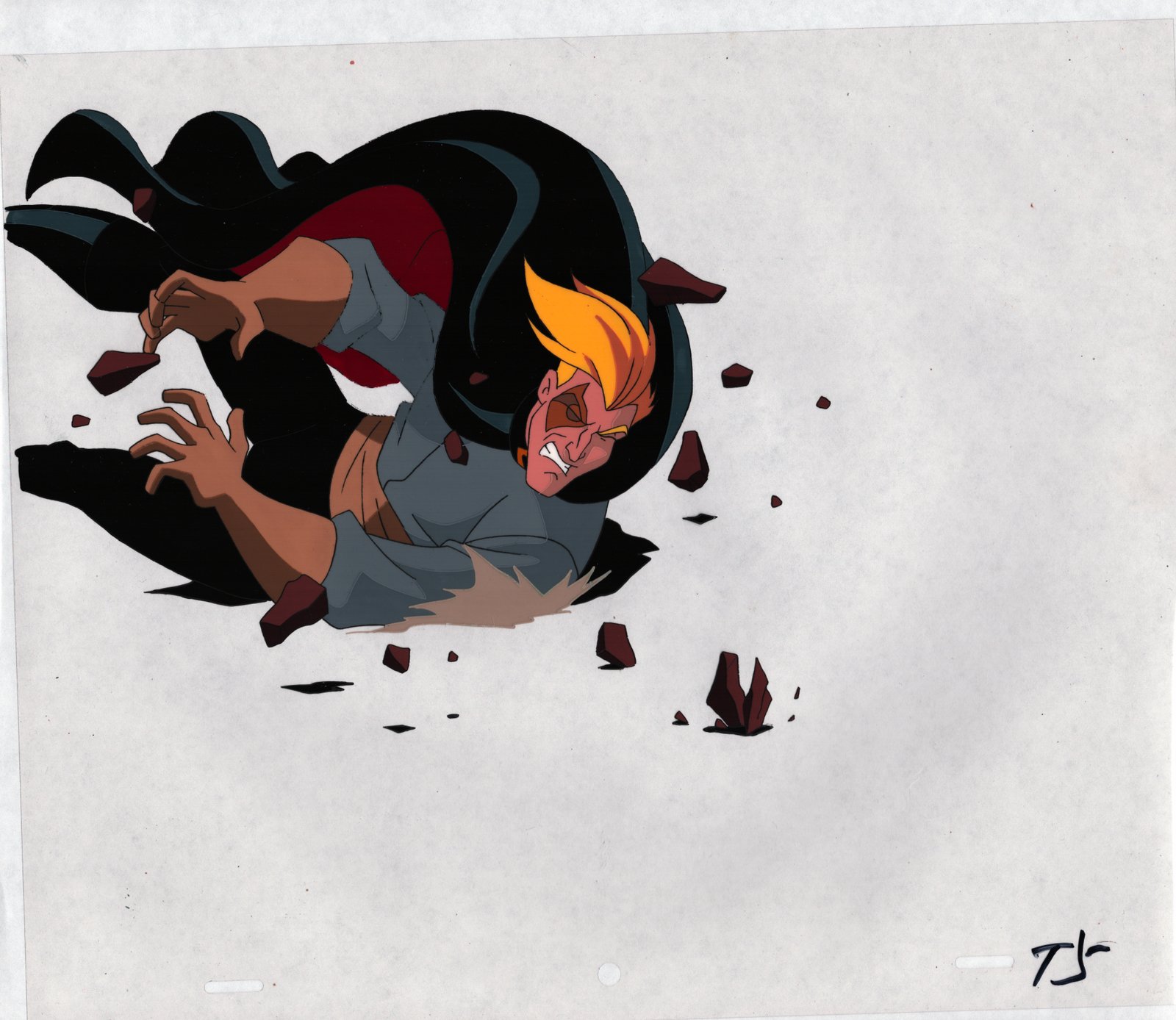
Original Animation Cel
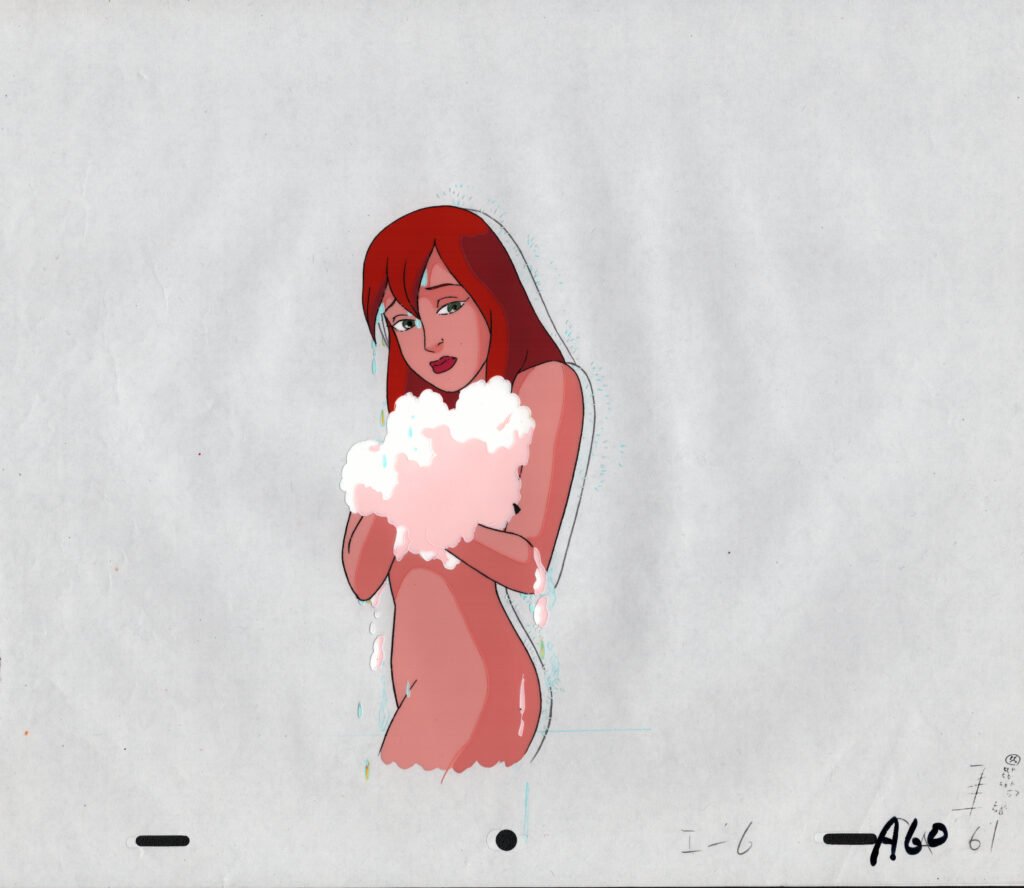
Original Animation Cel
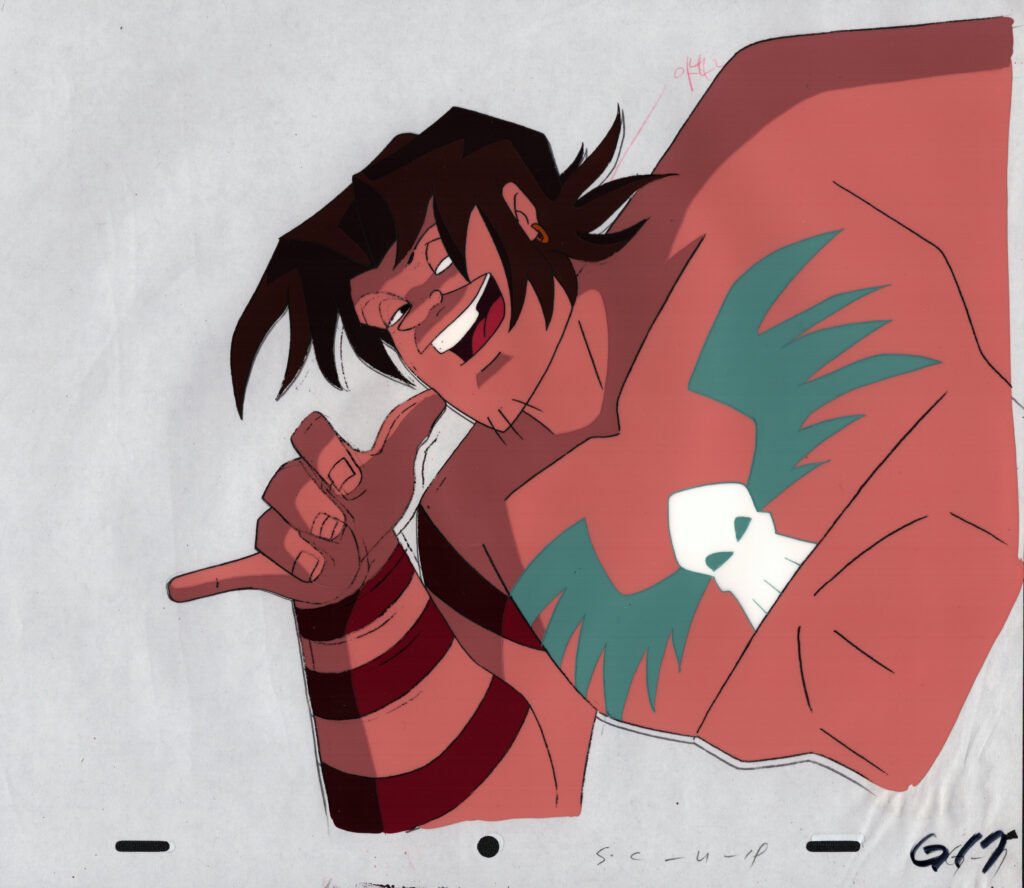
Original Animation Cel
The 1998 Premiere
On July 17, 1998, Gen 13 finally appeared in public at Wizard World Chicago. This was not merely a promotional trailer or a collection of unfinished scenes. The completed animated feature had arrived at the convention and could actually be seen. After years of development, delays, budget increases and changes in distribution plans, WildStorm finally had its movie.
The timing is important.
In the summer of 1998, the project could still be viewed as a legitimate upcoming release. The film had a public premiere, and the company had every reason to expect that audiences would eventually be able to purchase or rent it. There was even evidence of celebration around the production.
WildStorm held a Gen 13 Wrap Party during Summer 1998, and special Jones Soda bottle labels were created for the occasion. Two designs are documented: a Blue Bubble Gum Soda and Strawberry Lime Soda flavors. The labels retained the familiar Jones Soda format but incorporated Gen 13 artwork and the words “Gen 13 Wrap Party.”
The existence of a wrap party is nevertheless significant evidence that the production had reached its conclusion. After years of development and production, WildStorm was celebrating Gen 13 in the summer of 1998, shortly after the film’s public premiere. Whatever remained to be resolved on the distribution side, the production itself had clearly reached a major milestone.
The story, however, was not finished. Not even close.

Blue Bubble Gum Soda
Gen 13 Wrap Party
Strawberry Lime Soda
Gen 13 Wrap Party
WildStorm Is Sold To DC
Only weeks after the public premiere, the business landscape surrounding WildStorm changed dramatically. In September 1998, WildStorm and DC Comics announced an agreement in principle for WildStorm to become part of DC Comics and Time Warner. The acquisition was completed in January 1999.
This timing has become central to the mystery surrounding Gen 13. Disney had domestic distribution rights to a film based on WildStorm characters. WildStorm was now becoming part of DC Comics, which was owned by Time Warner.
The movie that Disney had agreed to distribute had suddenly become a property belonging to a major corporate competitor. And somewhere between the successful completion of the film and its intended American release, the release disappeared.
What Happened To The U.S. Release?
This is where the history of Gen 13 becomes less certain. The important facts are straightforward. The film was completed. It was publicly screened. Disney had acquired domestic distribution rights. WildStorm was subsequently acquired by DC/Time Warner. The film was never commercially released in the United States.
What is not straightforward is why.
No surviving official Disney announcement has been found that definitively explains the cancellation of the American release.
One frequently repeated explanation is that Disney no longer wanted to distribute a movie based on intellectual property owned by Time Warner. Given the timing, that theory is understandable. Once WildStorm became part of DC, distributing Gen 13 would effectively mean Disney marketing a property belonging to a major competitor.
Another explanation sometimes offered is that Disney objected to the film’s violence or mature material.
Neither explanation should currently be presented as proven.
In fact, the earlier contemporary reports that Disney was satisfied with the completed film and had abandoned plans for additional edits make it difficult to claim confidently that content was the reason the release was cancelled.
The exact reason remains undocumented, and that uncertainty is part of the film’s history.
The Movie That Wasn’t Quite Lost
Calling Gen 13 simply an “unreleased movie” can be misleading. It was released, just not in the United States.
The film eventually appeared on home video in a number of international markets, with Paramount handling international distribution. Releases appeared around 1999–2000, depending on territory, including the United Kingdom, Sweden, Germany, Hungary, Australia and Brazil.
The surviving releases are particularly important because they prove that the finished movie was not merely a convention screening or a production master sitting in a vault. There was a commercially distributed Gen 13. It just wasn’t the American release everyone had been expecting.
The Australian edition is especially useful because a surviving physical copy in the World Of WildStorm collection provides direct evidence for the film’s 86-minute presentation. The tape opens with Paramount branding and its end credits preserve several important pieces of the film’s distribution history, including the Buena Vista Pictures Distribution credit, a ©2000 Aegis Entertainment Inc. copyright notice, and identification of Gen 13 as a DC Comics property.
Those credits are particularly revealing because they preserve traces of several stages of the film’s history in a single release. Buena Vista’s involvement reflects the original domestic distribution arrangement, the 2000 Aegis copyright places the release after the original production, and the DC Comics designation reflects the change in WildStorm’s corporate ownership. The credits do not, by themselves, establish when or why those elements were added, but they provide valuable primary evidence of how the film was presented internationally.
Other modern databases list a shorter running time, so the existence of different published figures should be acknowledged rather than quietly treated as evidence of a different cut
In Britain, the film received a 15 certificate from the BBFC in September 2000, another indication that the eventual international home-video campaign was treating the film as material for an older audience rather than as children’s animation.
The Story
The completed movie adapts the basic origin of Gen 13 while reshaping the story for a self-contained animated feature.
Caitlin Fairchild is introduced as a teenager whose life changes after she becomes involved with a secretive military program. What initially appears to be an elite school is revealed to be connected to a government experiment involving genetically enhanced humans. Fairchild discovers that she possesses extraordinary abilities, while Grunge and Freefall also become involved in the unfolding conspiracy.
Colonel John Lynch investigates what is really happening behind the program and becomes increasingly concerned about the treatment of the young subjects. At the center of the conflict is Matthew Callahan, better known as Threshold, whose connection to the experiment and to Fairchild becomes one of the film’s major revelations.
The film condenses and reworks elements of the Gen 13 mythology to create a story that can stand on its own without requiring an audience to know the comics.
That was necessary. The movie was designed to introduce Gen 13 to an audience that might never have opened a WildStorm comic.
Differences From The Comics
The animated film is recognizably Gen 13, but it is not a literal adaptation of the early comics.
The movie concentrates heavily on Fairchild, Grunge and Freefall, with Lynch and Threshold playing major roles in the story. Several elements of the comic’s larger cast and mythology are reduced or omitted. Burnout and Rainmaker, for example, are absent from the principal group presented in the film, though both show up in cameo roles. The movie also reorganizes the Gen-Active mythology and reshapes the characters’ origin story to fit the structure of an approximately feature-length animated film.
That is one reason the film is interesting today. It is not simply an animated version of a particular comic issue. It represents the way WildStorm’s creators were translating their characters into a completely different medium at a moment when the company was trying to establish itself as a multimedia entertainment brand.
The Animation
The production’s animation history is itself a mixture of American and overseas work.
WildStorm developed the project through its Santa Monica animation operation, while animation work involved artists and studios outside the United States. Surviving credits identify numerous animators and animation personnel associated with the production, including artists who also worked for Korean animation studios.
The result reflects the animation environment of the 1990s, when American productions commonly combined American direction, design and production supervision with overseas animation labor.
The creative leadership, however, remained firmly connected to the American animation scene. Kevin Altieri’s direction and Glen Murakami’s early character-design work place Gen 13 within the same broader generation of American television animation that was redefining what superhero cartoons could look and feel like.
That makes the film something of a historical crossroads. It is a WildStorm comic-book adaptation made during the same era that produced some of the most influential American animated superhero productions of the decade.
The Voice Cast
The film assembled a surprisingly notable cast.
Alicia Witt voices Caitlin Fairchild, with John de Lancie as Colonel John Lynch. Flea voices Grunge, E.G. Daily voices Roxy Spaulding/Freefall, and Mark Hamill voices Matthew Callahan/Threshold. The supporting cast includes Lauren Lane as Ivana Baiul, Cloris Leachman as Helga Kleinman, John DeMita as Stephen Callahan and Kath Soucie as Rachel.
The presence of Mark Hamill is particularly fitting given the film’s connection to the emerging tradition of sophisticated American animated genre entertainment. Hamill had already become strongly associated with animation through his work as the Joker in Batman: The Animated Series.
For a direct-to-video comic-book movie that few people in the United States would ultimately see, Gen 13 had assembled an impressive group of performers.
Music
The score for Gen 13 was composed by Amotz Plessner and Joseph Magee. The soundtrack also incorporated contemporary music, including “The Piper” by Yossi Fine, performed by The Ex-Centrics.
The music reinforces another aspect of the production that is easy to overlook today: Gen 13 was being created as a product of the late 1990s, not as an attempt to imitate the style of earlier superhero cartoons. It was supposed to feel contemporary. It was supposed to feel like WildStorm.
And, most importantly, it was supposed to be the beginning of something larger.
The Multimedia Gen 13 That Never Happened
The animated movie was only one piece of the plans surrounding Gen 13.
There was discussion of an animated television series. Disney had acquired rights for a live-action film. WildStorm was expanding beyond comics and experimenting with animation, home video and potential film production at the same time.
For a brief period, Gen 13 looked like exactly the kind of property that could carry WildStorm into a much larger entertainment market. Instead, the animated movie became stranded between two corporate worlds. The film had been created under WildStorm. Disney held domestic distribution rights. WildStorm became part of DC Comics and Time Warner. The American release never materialized.
The larger franchise plans likewise failed to develop into the multimedia expansion that had once seemed possible. The movie survived, but its intended future did not.
Why The Gen 13 Movie Matters
The story of Gen 13 is tempting to reduce to a punchline. WildStorm made a movie. Disney bought it. WildStorm was sold to DC. The movie disappeared.
But that misses what makes the project historically interesting.
Gen 13 represents WildStorm attempting to solve a problem that many comic publishers faced during the 1990s: how do you turn successful comic-book characters into multimedia properties without surrendering the creative identity that made them successful in the first place?
The company’s answer was to build its own animation operation, hire established American animation talent, experiment with the OAV/direct-to-video model and seek a major distributor only after the creative work had been developed.
For a while, the plan worked. The movie was made. The movie was finished. The movie was shown to the public. Disney acquired the domestic distribution rights. WildStorm celebrated the completion of production. And yet the American commercial release vanished.
That makes Gen 13 more than an obscure animated movie.
It is a snapshot of WildStorm at a fascinating moment in its history: ambitious, independent, increasingly interested in film and animation, and suddenly standing on the edge of becoming part of DC Comics and Time Warner. The film itself eventually escaped into international home-video markets, where copies survived. Its production artwork survived. Its character designs survived. Even pieces of the promotional campaign surrounding its completion have survived.
That is why documenting Gen 13 matters. The story is not preserved in one perfect archive. It has to be assembled from contemporary reporting, surviving releases, production material, promotional artifacts, and the physical evidence that remains decades later.
And the movie itself survived. What disappeared was the future WildStorm had imagined for it.
That is perhaps the strangest part of the Gen 13 story. The movie was never really lost. It was finished. It was screened. It was distributed.
It simply never got the ending it was supposed to have.
Special Thanks
World Of WildStorm would like to thank and credit the following sources for their invaluable contributions to the research, documentation, and preservation of the history of the Gen 13 animated feature.
Rob Allstetter
Kevin Altieri
J. Scott Campbell
George Johnston
Jim Lee
Jeff Mariotte
Tom McWeeney
John Nee