

Gen 13: The Unreleased Video Game
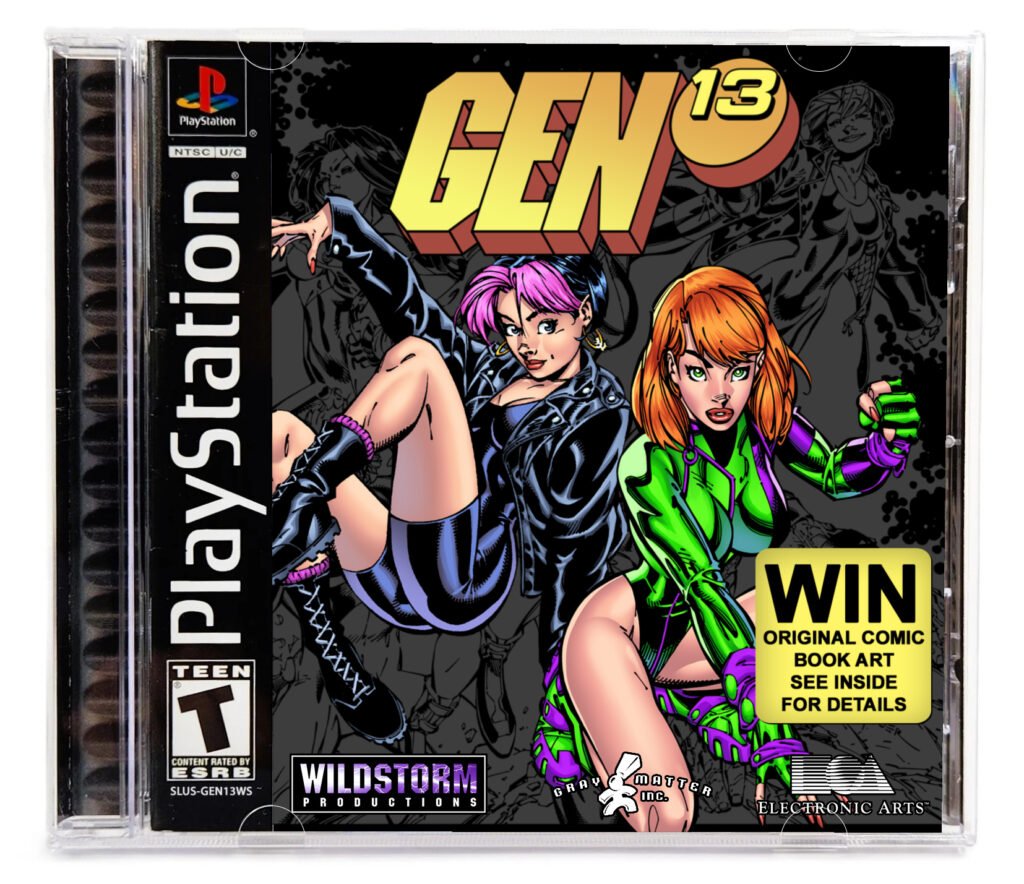
During the 1990s, WildStorm Productions was exploring opportunities to bring its comic book properties to audiences beyond the printed page. Video games were becoming an increasingly attractive way to introduce popular characters to new audiences, and Gen 13 was among the properties selected for that expansion. In 1996, Electronic Arts announced an agreement with WildStorm Productions to develop a series of video games based on the popular comic book series. The plans included releases for personal computers, Sony PlayStation, Sega Saturn, and other entertainment platforms.
What followed was an ambitious development project involving multiple studios, original game designs, and contributions from some of the most recognizable names associated with Gen 13. Although the game eventually reached the prototype stage, it never made it to store shelves. The project was cancelled before completion, leaving behind an interesting chapter in WildStorm’s history.
The Licensing Agreement
Electronic Arts announced that it had secured exclusive worldwide interactive software rights to the Gen 13 comic book series from WildStorm Productions. The agreement gave EA the rights to develop a series of two-dimensional and three-dimensional action-adventure games featuring the characters and stories created by Jim Lee, Brandon Choi, and J. Scott Campbell.
According to the announcement, the games would be developed for personal computers, Sony PlayStation, Sega Saturn, and other advanced entertainment platforms. Jim Lee expressed enthusiasm about working with EA, noting that he and Campbell had met with the producers and were confident the company could capture the look, humor, and personality of the comic book series.
The agreement represented an opportunity to take one of WildStorm’s most popular properties into an entirely different entertainment market. Rather than simply adapting the comic books, the intention was to create an interactive experience that incorporated the characters’ individual powers and personalities.
Developing The Game
High Score Productions, the company previously responsible for games such as Madden NFL 95 and NHL 95, was assigned the original game design and production planning. The initial concept combined elements of several successful video games, including the platforming and exploration of Super Mario, the action and shooting of Earthworm Jim, and the fighting mechanics of Street Fighter.
The design called for five playable Gen 13 characters, each with individual abilities, animations, and special moves. Players would encounter different types of gameplay throughout the adventure, including side-scrolling action, shooting sequences, vertical shooter sections, and three-dimensional boss encounters.
The game was also intended to support two-player cooperative gameplay, allowing both players to control characters simultaneously. During certain team-up levels, additional Gen 13 members would appear under computer control to assist the player.
One of the more interesting features was the Ultra Move. Each character would have a special attack representing the ultimate manifestation of their Gen Active powers. These abilities would be hidden throughout the levels and could be discovered as players progressed through the game.
The original design outlined 25 conceptual levels, with a variety of environments and gameplay challenges. Some of the proposed locations included Las Vegas, an underground complex, and a shopping mall. Individual stages would incorporate skating, driving, flying, swimming, climbing, and fighting on ice.
The design team also planned to introduce original enemies and bosses created specifically for the game. Jim Lee and J. Scott Campbell were commissioned to contribute designs for the encounters, including a major final opponent that would require the entire Gen 13 team to defeat. The plan even called for this character to make an appearance in an upcoming Gen 13 comic book story.
Finding A Developer
With the original design work completed, Electronic Arts began considering proposals from potential development studios. Three companies were selected to submit technical demonstrations showing how they envisioned bringing Gen 13 to life: Evolutionary Publishing, Realtime Associates, and Gray Matter Inc.
Each studio approached the assignment differently.
Evolutionary Publishing submitted two interactive demonstrations featuring Rainmaker and Qeelocke. The characters could be moved through a platform-style environment based on the proposed Las Vegas level. One of the demonstrations even allowed Rainmaker to climb the exterior of a pyramid. Evolutionary chose to represent the characters using two-dimensional sprites.
Realtime Associates took a different approach, creating a playable three-dimensional demonstration featuring Freefall. The studio reportedly put the demonstration together in less than a week. Although the character model and animations still needed refinement, the submission provided an opportunity to demonstrate the studio’s technical capabilities.
Gray Matter Inc. submitted a non-interactive presentation showcasing its proposed graphical direction. The demonstration included character artwork, an end-boss design, and a fly-through of the proposed underground level, Down In It. Its presentation ultimately impressed Electronic Arts, and Gray Matter was selected to develop the game.
The three demonstrations provide an interesting look at how differently the same property could have been interpreted. Realtime Associates’ version is particularly interesting because its technical demonstration can still be experienced today through the video game preservation website Games That Weren’t.
Gray Matter Takes Over
Gray Matter Inc. was a Canadian video game developer founded by Chris Gray in 1985. Originally operating as Chris Gray Enterprises, the company developed games for several computer and console platforms throughout the 1980s and 1990s. Its credits included Infiltrator, Fiendish Freddy’s Big Top O’ Fun, Dirty Harry, and Perfect Weapon.
Following its selection by Electronic Arts, Gray Matter began work on the Gen 13 game. The project was intended for both PlayStation and PC, with the PlayStation version receiving particular attention during development.
According to the PlayStation Museum’s account, after only a few months of programming, Gray Matter had developed two interactive levels, an arena combat mode, and full-motion video sequences. Three playable characters had been created for the side-scrolling levels, along with their accompanying enemies. The arena mode included four characters and an enemy boss.
The project was considerably more involved than the original demonstrations submitted during the selection process. Gray Matter had moved beyond its initial graphical presentation and was actively developing the game.
What The Game Looked Like
The planned game combined traditional side-scrolling action with three-dimensional combat encounters. Players would be able to explore different environments, battle enemies, and use the individual powers of the Gen 13 characters.
The arena mode was particularly ambitious for a comic book adaptation of the period. Rather than keeping every encounter within the familiar side-scrolling format, the game would move into a three-dimensional environment where the camera adjusted its position depending on the distance between the player and the boss.
The original design also included a number of additional features intended to reward exploration. Hidden arcade-style bonus games would offer opportunities to earn points and extra lives. The possibility of licensed music was also discussed, with Thomas Dolby, Mark Mothersbaugh, and the Red Hot Chili Peppers among the names considered. These were proposed musical possibilities, not confirmed licensing agreements.
Perhaps the most unusual connection to the comic books involved the final boss. Jim Lee and J. Scott Campbell were expected to create a character that would eventually appear in a Gen 13 comic book story. Players who completed the game might also have been able to unlock a secret code and request a poster featuring the character.
Had the project reached completion, it could have introduced new material into the Gen 13 universe rather than simply adapting stories that readers already knew.
Cancellation
Despite the progress made by Gray Matter, the Gen 13 game never reached completion.
The PlayStation Museum reports that the business relationship between Gray Matter and Electronic Arts eventually reached an impasse. According to its account, the disagreement resulted in Gray Matter closing its operations and ending development on its active projects.
Electronic Arts reportedly considered the money already invested in the game, along with declining interest in the Gen 13 property, and decided that bringing another developer on board was not financially worthwhile. Rather than continue development, EA abandoned the project.
The same account states that many former Gray Matter employees subsequently found work with EA Canada, where they went on to develop Knockout Kings.
Although the precise circumstances surrounding the disagreement between Gray Matter and EA still need additional verification, the result was that Gen 13 lost its opportunity to become a commercially released video game.
What Remains Of The Project
The history of the Gen 13 game has been documented through its original design information, developer demonstrations, and prototype material. The PlayStation Museum has assembled an extensive account of the project, including images from the different development submissions and screenshots of the Gray Matter PlayStation version.
The Realtime Associates demonstration was also made available through Games That Weren’t in 2012, giving visitors an opportunity to experience one of the original submissions that did not receive the development contract.
There is also an important collection of original development material held by the Brian Sutton-Smith Library and Archives of Play at The Strong National Museum of Play in Rochester, New York.
The collection includes Electronic Arts’ 1995 Gen 13 game design documents, the 1996 preliminary script titled Ton of Bricks, and a 1997 Gray Matter Gen 13 demo disc. The materials were donated to the museum by the PlayStation Museum in January 2014.
The inclusion of the Gray Matter demo disc is particularly significant because it establishes that an actual development disc from the project is held in an institutional archive. The original design documents and preliminary script offer additional opportunities to learn more about what Electronic Arts and WildStorm had planned.
A Game That Never Made It To Market
The Gen 13 video game was an ambitious undertaking that brought together Electronic Arts, WildStorm Productions, and several video game development studios. From the original design work by High Score Productions to the eventual selection of Gray Matter, the project went through several stages before development came to an end.
The plans included multiple playable characters, a variety of gameplay styles, original enemies and bosses, and even a connection to the comic book series itself. Gray Matter had made considerable progress before the project was abandoned, leaving behind a fascinating glimpse of what could have been.
For WildStorm, Gen 13 represented an opportunity to take one of its most recognizable properties into the growing video game market. Unfortunately, the game never made it beyond development, and the PlayStation release that might have introduced Gen 13 to an entirely new audience never happened.